Interview
December 06, 2025
Surgeon in Exile Offers an Alternate Perspective on Sudan’s Devastating War




By
Ashenafi Endale
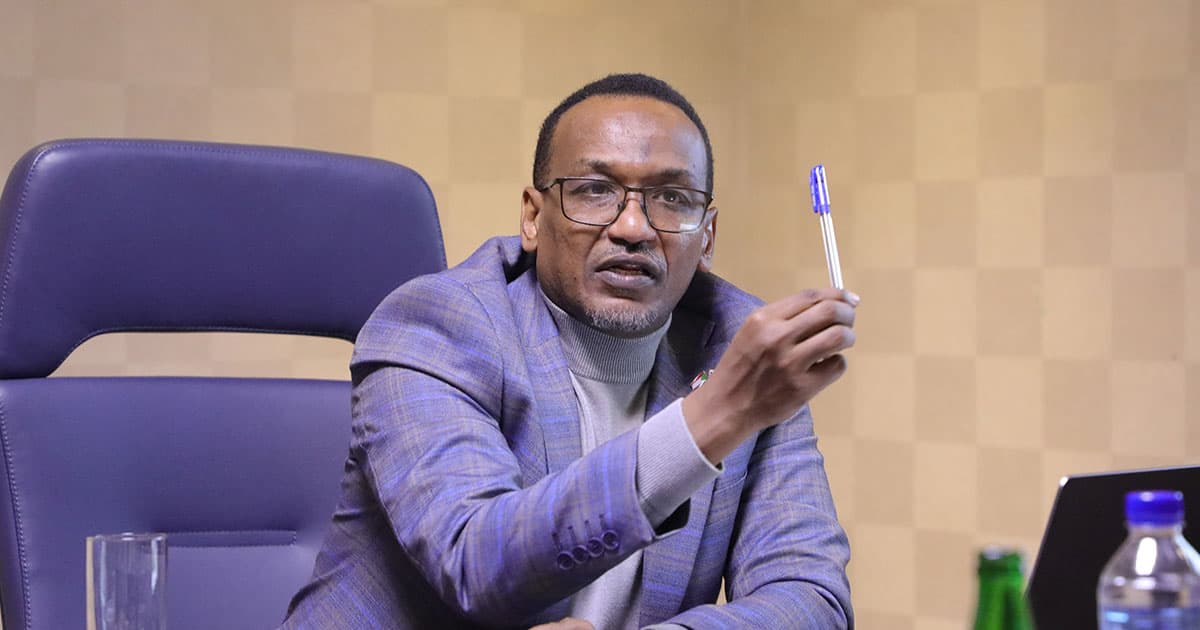
Dr. Alaaeldin Awad Nogoud is a Sudanese medical surgeon whose foray into politics in 2018, ahead of the revolution that ousted longtime ruler Omar Al-Bashir, has led on an eventful journey that has seen him flee Sudan twice and eventually assume a position as official spokesperson for the Tasis government led by the Rapid Support Forces (RSF), which have been locked in a deadly conflict with the Sudanese Armed Forces (SAF) for close to three years now.
Nogoud was a member of the Sudan Professionals Association (SPA), which spearheaded Sudan’s 2019 revolution, and has had a unique perspective on the events that have unfolded in the country over the past six eventful and difficult years.
Nogoud shared his side of the story during an interview in Addis Ababa this week with The Reporter’s Ashenafi Endale. EXCERPTS:
The Reporter: What role did SPA play in the 2018 revolution?
Alaaeldin Nogoud (Dr.): SPA has been the major opposition since the Muslim Brotherhood came to power in 1989. The Association remained an ardent force of change throughout Al-Bashir’s regime. The community of doctors [in Sudan] organized a major strike in 2013, to mention. The SPA was the body that ignited the revolution in 2018.
Then SPA on-boarded political parties to join the revolution. It became an agent of change. The united doctors office was supervising the strikes, every week throughout the protests. Finally, we succeeded in ousting Al-Bashir.
At the time, RSF and SAF were together. The transition started, and the coup happened in October 2021. The RSF rejected the coup, stating the Muslim Brotherhood was behind it. RSF and the transition were cheated by the Brotherhood.
The Muslim Brotherhood infiltrated the Sudanese army, intelligence, and other offices and security forces. Even the CSOs are dominated by the Muslim Brotherhood of the Al-Bashir regime. Many international media outlets report against the RSF, citing atrocities, rape, and other issues. This is because the CSOs are backing the Muslim Brotherhood and producing reports that support SAF. There is atrocity, but not like what the media and CSOs are reporting.
Eventually we reached a framework agreement aimed at bringing back the transition. I was one of the signatories. But just when we were about to reach an agreement, SAF ignited the war. Immediately, members of the SPA, including myself, were detained by the SAF. They released me following media pressures. Then I fled to Ethiopia.
The Sudanese Coordination of Civil Democratic Forces (Tagadum) failed and then we formed Tasis [The Sudan Founding Alliance]. I went to Nairobi to sign the agreement, and then back to Sudan as minister of health of the Tasis government. Then, again, I fled to Ethiopia.
In a nutshell, the SPA was the core igniting force of Sudan’s revolution. Then we joined the political coalition, the FFC. We were against the coup. We wanted change for our country, and a good future for our people. We wanted to get rid of the Muslim Brotherhood.
The problem now is that the people of Sudan do not understand the real cause behind the crisis. Even the international community and international and regional organizations do not understand what the real reasons behind the war are. That is why they fail to define the problem and forward a solution.
Why did the revolution fail?
Sudan was colonized by Egypt between 1820 and 1885. The people fighting the Egyptian, Turkish and British colonizers at the time were from Darfur. That is why people say history is repeating itself, because Egypt still controls Sudan today.
Egypt is behind all the coups in Sudanese history. Egypt has a deep hand in the Sudanese military and political parties, among others. The leaders of the military and some of the political parties are controlled by Egypt. That is why it remains difficult to resolve Sudan’s crisis, because Egypt is backing SAF in this war. Egypt is always working behind the scenes to have a loyal regime in Sudan. Sudan’s aspirations for an independent government are totally against Egyptian interests.
The main reason Egypt is involved in Sudanese politics is because of the River Nile. SAF backs Egypt’s interests on the Nile. That’s why Egypt is backing SAF.
But, the war in Sudan now is not only a war between RSF and SAF.
Sudan gained independence in 1956, from the Anglo-Egyptians. Since then, Sudan has been controlled by certain elite groups, or elite tribes, or elite families. They are mostly from north and central Sudan, with some from Darfur and Kordofan. These elites control Sudan’s political-economy, and social decisions. There has never been a PM or president of Sudan who is not from this elite group. The group is not of a certain ethnicity, as such, but is rather a trans-ethnic entity. This group has been enjoying high-class benefits since independence, and does not want power to be shared by anybody outside it.
So, the 2018 revolution was against this static elite power group. The fight was between the old Sudan, and the new Sudan. The revolution was against the Muslim Brotherhood. The Brotherhood took over Sudan’s political economy when Al-Bashir came to power through a coup in 1998. The Brotherhood embedded itself within Sudan’s existing elite ruling class.
So, the real war is between people who want an equal Sudan, and an elite ruling group who wants to maintain the status quo. The children and siblings of people in the elite group can rule Sudan, while its citizens cannot even if they have the capacity.
The real war is not just between SAF and RSF. If you simplify the war into these two groups, then you reach the wrong conclusion, which many are doing. Dr. John Garang was among the first to initiate military opposition against the ruling class. There are countless peace agreements between the groups, but no actual deal. None has addressed Sudan’s real cause.
Both Al-Bashir and Al-Burhan are regimes of the Muslim Brotherhood. They are dictators, totalitarian and take any action to quash public outcry.
Sudan is not an Islamic Arab government but all the governments since 1956 have insisted on defining Sudan as Islamic Arab country. Sudan is diverse and multi religious. But these regimes have been imposing an Islamic state over the African ethnicities of Sudan. This has jeopardized the rights of many.
All the military coups in Sudan have been backed by Egypt. Egypt has been the main source of Sudan’s problems since 1956. Officers in the Sudanese army, including Al-Burhan, are loyal to Egypt. Egypt is supporting SAF militarily, politically, diplomatically and in all aspects. There is surmounting evidence for this, including from Egyptian scholars.
Why is Egypt involved in Sudanese politics?
Egypt does not want an independent Sudanese government that works for the sovereignty of Sudan and the interests of the Sudanese people. Egypt controls Sudan’s army, hence they are always behind every coup in Sudan. Egypt does not accept a civilian government in Sudan, or any government that is not loyal to Egypt.
The Nile waters agreement of 1959 should be scrapped, and we should look forward to a new agreement. We don’t want Egypt to exploit Sudan’s resources anymore. Egypt should stop dominating Sudan in the Arab summits. Egypt should no longer control our political decisions. These are our positions and the Sudanese people’s demands, but Egypt does not accept this. This is why it supports SAF.
In this context, how do you put into perspective the shifting alliances and rivalries in the Horn of Africa?
This is why Isaias [Afwerki] went to Egypt, Somalia and, a few days ago, to Sudan to meet SAF officers. There are forces who have forged an alliance with SAF. This alliance also has an interest of force to encircle Ethiopia from the south. Egypt has SAF in place to protect its interests in Ethiopia, but if SAF should fail, Egypt has prepared Somalia as a second option to influence Ethiopia. So, Egypt has forces both north and south of Ethiopia. Egypt uses leverage to secure its interests in Ethiopia. That’s why Egypt spoils not only the peace of Sudan, but of the Horn.
That is why the region’s countries must have a strong position against Egypt. The AU and other organizations also need to change their frame and mindset on issues concerning the Horn and Egypt. Otherwise, the Horn cannot realize peace, development and prosperity.
Reports presented to the UN indicate that Egypt transferred Iranian chemical weapons to SAF. The reports show that Egypt has been amassing benefits from the Sudan war. Sudanese gold worth eight billion dollars has been smuggled into Egypt since the war, according to a report presented to the UN. In fact, Egypt’s gold reserves have grown five-fold since the war began. Their gold exports grew eight-fold.
Egypt has also been utilizing six billion cubic meters of water from the River Nile, which is Sudan’s share. There is evidence that SAF uses weapons and ammunition manufactured in Egypt.
Why are people saying the UAE is backing RSF, while not a single bullet from the UAE has been tied to RSF? And why do people never say that Egypt is backing SAF, despite the evidence?
Besides Egypt, the Muslim Brotherhood and its network—people in Qatar, Cairo, and Istanbul—are backing SAF.
SAF is fighting on behalf of the global Muslim Brotherhood network. They are aligned with ISIS, Hamas, Hezbollah, and backed by Iran, among others. Even some TPLF [Tigray People’s Liberation Front] units are currently fighting alongside SAF.
Who are other supporters of SAF?
Any Muslim brotherhood organization, including Boko Haram, Al-Shabaab, Al-jihad, ISIS, Hamas, Hezbollah, and Iran are backing SAF.
Sudan is the only country where Muslim Brotherhood extremists have managed to assert power, aside from Afghanistan. Al-Bashir was a Muslim Brotherhood regime. During his rule, Sudanese passports were sold to all kinds of Muslim extremist groups and jihadists around the world. Osama Bin Laden and others were in Sudan at some point. It was host to terrorists, jihadists, and extremists.
The International University of Africa in Khartoum is their instrument for expanding their extremist ideology across Africa. This university is the work of the Muslim Brotherhood organization. It brings scholars and students from all over Africa, brainwashes them with its ideology, and sends them back to African countries to implement the extremist ideology. The Muslim Brotherhood will boldly claim that they will own Africa not through war but through the words of these students and scholars from the university.
We closed the university during the transitional government of Sudan.
What benefits does Egypt get by supporting SAF?
Currently, the Egyptian army is 80 kilometers inside Sudanese territory, mining for gold. Al-Burhan has said nothing about this. The triangle where Sudan, Egypt, and Libya meet is key. When RSF advanced to control this triangle, it became very dangerous for Egypt. That is why the war in Sudan has escalated now.
After the first coup in Sudan in 1958, which was backed by Egypt, the 1959 water Nile agreement was signed. Egypt took 33 billion cubic meters of water from the Nile, and Sudan took 18 billion. Plus, Egypt receives water loans from Sudan. Since 1959, Sudan has been giving 1.6 billion cubic meters of water to Egypt as a loan. We do not know when or how Egypt will repay.
So, the reason Egypt is keeping a loyal government in Sudan is to maintain this agreement and all the benefits. Egypt calls itself ‘the Rose of Nile’ and aims to maintain its share of the river by any means.
Sudan’s first revolution was in 1964, but Gafaar Nimeiry conducted a coup backed by Egypt. The second coup was also undertaken by Egypt. Nimeiry, who was initially communist, managed to sustain his power after he shifted his alliance to the Islamists in 1971. In 1989, Egypt took full control of Sudan by bringing Al-Bashir to power through another coup. Bashir was an Islamist. Then, Bin Laden, Alzawhari, Hamas, and others came to Sudan. They have investments in Sudan.
How are Janjaweed, RSF and Hemedti related to the atrocities being committed in Sudan?
There is a misnomer that wrongly equates Janjaweed with RSF. This is totally wrong. The real Janjaweed that committed atrocities, was created in 2003. At the time, Al-Burhan was head of the western infantry. Al-Burhan gave orders to military leaders under him to commit the atrocities. Ali Muhammad Ali Abd-Al-Rahman [Ali Kushayb], who took orders from Al-Burhan, carried them out. Al-Bashir, Al-Burhan, and other officers were responsible for the atrocities.
Right now there are three people wanted by the ICC [in connection with the atrocities]: Al-Bashir, Ahmad Arun, and Abdelrahim Mohamed. These three are currently enjoying life in a luxury resort in Shendi, in SAF-controlled northern Sudan. The ICC has issued requests, but Al-Burhan refuses to hand over Al-Bashir.
In 2013, there was a military coup attempt organized by [Hassan] Al-Turabi, a member of the Islamist Popular Congress Party. As a result, Al-Bashir put Al-Turabi in jail and that was the time when he created the RSF. Hemedti was there. Al-Bashir formed the RSF to protect himself from extremists in the army, who were loyal to Al-Turabi.
Janjaweed was created in 2003, and RSF in 2013. Janjaweed is not RSF, and vice versa.
To know who is fighting who in Sudan, and why there can be no solution, one must know the history and genesis. The international media space concludes that RSF is Janjaweed. They want to blame RSF for all the atrocities committed by others in the past in Sudan. This propaganda is created to designate RSF as a terrorist organization. So all the massacres, ethnic cleansing and others committed by Janjaweed are now on the shoulders of RSF. RSF has nothing to do with Janjaweed. SAF is twisting this fact, and unfortunately it is believed by international media. This twist continues fueling the conflict in Sudan.
Where is Al-Bashir?
He is enjoying life in a resort controlled by SAF.
Are Sudanese forces aligning themselves along Arab and African ethnicities in Sudan?
The Muslim Brotherhood also created conflicts between the Arab and African tribes in Sudan, between the pastoralists and farmers of Sudan. They arm one against the other. Tasis managed to bring these people together for the first time. SAF divided them to rule, but RSF united them. All tribes and diversities of Sudan are represented in the Tasis alliance government.
That is why the Tasis government based in Nyala is threatening Port Sudan-based SAF and Muslim Brotherhood. Just like they divided Sudan into South Sudan and Sudan, the Muslim Brotherhood are again going to divide Sudan. RSF is fighting to prevent Sudan’s division.
Is RSF responsible for the atrocities committed recently in Al-Fasher?
Al-Fasher was intentionally dragged into the war by SAF, despite the city reaching an agreement with RSF to keep it from entering the city. But many Arab media were intentionally distorting the facts regarding Al-Fasher, including through fake AI videos. RSF suspended its collaborations with Arab media. Even the Yale Humanitarian Lab participated in distorting facts, which were later debunked by French media.
After Al-Fasher, many AI-generated videos emerged on international media as part of a campaign against RSF. In reality, SAF destroyed Al-Fasher and other many residential areas with explosives. RSF helped tens of thousands residents to safe areas, and provided humanitarian aid. But no media reports this. SAF forces charge hundreds of dollars per head to allow IDPs to pass to safe areas. SAF has committed a lot of war crimes. Whenever we send authentic videos to Aljazeera and other Arab media, they never cover it.
What portion of Sudan’s geography does RSF control at the moment?
Right now, RSF controls 60 percent, including Darfur and Kordofan. SAF controls 40 percent, including Khartoum. RSF can advance to the capital.
Why have attempts at dialogue failed?
There were many peace talks and agreements including Jeddah, IGAD, Geneva and Washington. All were spoiled by SAF. The humanitarian truce was also refused by Al-Burhan.
We do not know what the international community is going to do with Al-Burhan, unless they force him to sign a peace agreement. But Al-Burhan and the Muslim Brotherhood will never accept a peace agreement. That is what we are telling the international community now. These people are not peaceful people. The international community must realize that SAF will destroy everything to take power. Dealing softly with Al-Burhan is very dangerous. If Al-Burhan takes power, he will bring all the extremists and jihadists to the Horn of Africa, including Hamas, Hezbollah, Houthis, ISIS, Boko Haram, and others. This will be very bad for the Horn, the Sahel region, and the whole Africa.
The international community must push to cut off all financial support to SAF and the Muslim Brotherhood. These forces have various businesses. Their accounts, trades, and financial activities must be closed. Their officials must be banned from traveling. Whether it is in Turkiye, Qatar, or Egypt, the Muslim Brotherhood must be stripped of all access. Countries that are backing SAF and the Muslim Brotherhood should be sanctioned. AFRICOM, the East African Standby Force and others must target their positions.
SAF and the Muslim Brotherhood will never respond to ordinary peace talks. They never go for peace through negotiation.
Who is backing who in this complicated war?
The question should be why are they backing any of the two? Evidence is also important to cite.
If the world is really against terrorism, and does not want jihadists to be harbored in the Horn of Africa, it must stop anybody from supporting SAF. If the world does not support RSF, it must at least see the danger SAF poses.
How did the parties fail to protect civilians and avoid war in Khartoum?
War inside Khartoum was avoidable. RSF refrained from fighting in Khartoum, until SAF surrounded and fired on our forces there. Then things escalated. Every war has atrocities. To stop the atrocities, you must stop the war. Worst is, SAF gains benefits from the war.
Disturbing videos have recently surfaced that appear to implicate members of the RSF in violence and atrocities committed against civilians. Is RSF responsible for these acts?
Most atrocities committed in areas under RSF control are carried out by undercover SAF intelligence officers who have infiltrated RSF. After committing atrocities under the banner of RSF, they defect to SAF and are welcomed as heroes.
What is the role of Tasis?
Take Ethiopia as an example. Mengistu used revolution to oust Haile Selassie. But after coming to power, Mengistu led the military, and lacked covilian givernance. Hence, he did not succeed in transforming and stabilizing Ethiopia. RSF learned from this. RSF is a military wing, so it needs to surround itself with a civilian government. Tasis is that civilian government. In any country, the military and civilian government must work side by side. You cannot build a country with an army. That is the essence of Tasis.
How do you see the AU’s approach to the war and crisis in Sudan?
The AU failed to do its job. During the last Arab summit in Baghdad, AUC head Mahmoud Ali Youssouf made a statement praising the military gains of the SAF. While Egypt was chair of the AU Peace and Security Council, senior Egyptian and AU officials visited SAF leaders in Port Sudan and pledged to open a liaison office there. They branded the RSF simply as rebels.
The African Union’s position on Sudan is very bad. IGAD is much better. Some countries like Ethiopia, Rwanda, and others understand the real situation. IGAD leaders know why South Sudan seceded. The AU is not capable of solving the Sudan case, unless they change where they are standing.
Ethiopia is pursuing access to the sea. What will regional power alliances mean for its ambitions?
The alliance of Isaias, Al-Burhan, and Egypt will spoil the Horn’s peace and stability. They might escalate the participation of TPLF with Al-Burhan. They can escalate the tension between Ethiopia and Eritrea, and also escalate things between Somalia, Eritrea, and Egypt. That is why we urge that practical, powerful and strong action is required to stop this alliance. Condemnations and asking these people to sit for negotiations will not bear any fruit. There should be something strong, practical.
For instance, a military alliance against this axis, or a peacekeeping mission against this axis, is necessary. The Muslim Brotherhood must be denied a stronghold in the region. The international community should plan for peacekeeping or military intervention against Al-Burhan. Even if SAF reaches a peace agreement with RSF, the Muslim Brotherhood will sabotage that and continue the crisis.
How does the RSF view the Al-Fashga border dispute with Ethiopia?
Al-Burhan, just like Al-Bashir, has a trend of externalizing domestic problems. Whenever there is a domestic issue, they create an agenda with neighboring countries. Al-Fashga is an unnecessary agenda created by Al-Burhan, just to mobilize the Sudanese people behind himself.
Al-Fashga can be easily solved. Even Ethiopia’s sea access interests can be solved easily. Railway networks can come to Port Sudan, Eritrea, and other coastal countries to ensure and diversify Ethiopia’s port access.
What is your response to claims that RSF is heavily involved in smuggling gold out of Sudan?
Many claim RSF is involved in the gold trade with the UAE. In fact, it is the SAF who is smuggling gold to the UAE and other countries.
Comments
No comments yet. Be the first to leave a comment!
Leave a Comment
Society
Old Jaffa, New Tel Aviv
November 22, 2025
Society
“Now, It’s My Land”: Legal Reform Transforms Women’s Ownership in Rural Ethiopia
November 15, 2025

Society
A Gift of Technology — and Hope — for Koye’s Students
November 08, 2025
Society
Data for a Changing Climate: From Soil to Strategy
November 01, 2025
Society
Harnessing Data, Driving Innovation: Securing East Africa’s Water Future
October 25, 2025
Society
Bridging the Health Gap: Ethiopia’s push for Equitable Health
October 18, 2025
Art
Blending traditions: A taste of Italy, Crafted with Ethiopian ingredients
December 06, 2025
Art
Between Tradition and Trend: Ethiopia’s Musical Identity in the Modern Era
November 29, 2025
Art
Ethiopia’s Living Heritage in the Holy Land
November 22, 2025
Art
The Door that Never Closed: Honoring Getnet Enyew
November 15, 2025
Art
Echoes of Memory
November 01, 2025
Interview
December 06, 2025
Surgeon in Exile Offers an Alternate Perspective on Sudan’s Devastating War

Interview
December 06, 2025
Ethiopia-Israel Relations: Diplomacy, Investment, and Strategic Partnerships
Interview
November 29, 2025
A Peek into Ethiopia’s E-mobility Race
Interview
November 22, 2025
Nuclear Scientist Cautions against Ethiopia’s Newfound Atomic Ambitions
Interview
November 15, 2025
Unresolved Obligations, Widening Fractures Weigh Heavily on Tigray’s Opposition Parties

Interview
November 15, 2025
’We Recorded the Destruction Scientifically’
Interview
November 08, 2025
‘Something is Broken Somewhere’: A Think Tank on Bridging Intergenerational Gaps and Addressing the Youth Crisis in Ethiopia
Interview
November 01, 2025
Building a Resilient Health System: Ministry Banks on Alternative Financing Models amid Dwindling Aid