Art
November 15, 2025
The Door that Never Closed: Honoring Getnet Enyew




By
Nardos Yoseph
Meaza Worku still remembers the first time she stepped into the Ethiopian National Theatre—a cavernous building whose silence feels older than its walls. She was a young university student then, knees trembling, notebook pressed to her chest, arriving for a modest make-up course project titled Yeametsa Lejoch (“Children of Rebellion”). She expected to collect research. She did not expect her life in theatre to begin.
At the center of that memory, descending the theatre’s staircase with a warm, familiar face, was Getnet Enyew.
He was not yet the legend she would come to revere—the writer, director, actor, poet whose work generations of artists now cite with devotion. He was simply a kind man walking down a staircase, offering help to a nervous student.
“The first person who welcomed me warmly, with a loving, radiant face, was Getnet,” Meaza recalls, with the tenderness of someone replaying a defining moment. “Writer, director, actor—yes. But to me, in that moment, he was the first hand that led me into Ethiopian theatre,” says the now-renowned dramatist and director.
Her appointment that day had been with Tesfaye Gebremariam, then the theatre’s production director. But fate introduced someone else first. She remembers Getnet’s steps—light, almost playful. His voice: How can I help you? And the shock: she had only ever seen him on the television drama Aba Koster, or as the author of Senebet, a text students whispered about like a rite of passage.
She was trembling. He noticed.
Getnet opened a door “that looked exactly like the wall itself,” she says—a door she would later learn led to the shared office he occupied with Tesfaye. “Sit; I’ll keep you company so you won’t stay here alone,” he told her, pulling up a chair and easing into gentle, curious conversation.
Who is teaching you? What is your research about? You chose theatre intentionally? Is that why you joined? His questions carried the softness of someone guiding a young artist toward her first step. Keep at it, he told her, as if granting permission to belong.
“To this day, I still answer him with respect whenever he calls me. I have never—and will never—speak to him casually or lightly,” Meaza says.
Thirty minutes later Tesfaye arrived. Getnet stood, smiled, and said, “I kept her entertained until you came.” Then he slipped back to work.
Some encounters rearrange your understanding of the world. Some people pass briefly through your story but leave an imprint that refuses to fade. For Meaza—and for many who walked those same corridors—Getnet was one of those people: unexpected, gentle, quietly transformative.
And on November 10, 2025, inside the same National Theatre whose doors he opened for so many, Ethiopia gathered to return the honor.
Long before the awards, before the five-million-birr prize, before the ceremonial cloak draped over his shoulders, Getnet was a boy who loved stories. That love grew into more than 17 written plays, more than 23 produced works, and participation in over 27 stage productions—an output that forms one of the most enduring artistic legacies in modern Ethiopian theatre.
His works—both translated and original—span eras, emotions, histories, and moral questions. Among them: Yelilit Rigboč, Wubetin Filega, Wey Addis Ababa, The Vision of Tewodros, Empress Taytu, Aba Kostir, and Misteregnochu.
His stage productions include the beloved Balekabana Baladaba, Alula Abanega, Free Criminals, The Merchant of Venus, Yechognaw Mize, Wuchale 17, The Cursed Apostle, and Hamlet.
These plays are not merely performances—they form part of a cultural archive Ethiopia is still building, works crafted with discipline and a quiet devotion to the craft.
His influence extended far beyond the stage. Getnet wrote and performed in radio dramas, shaped characters for television, published a poetry collection titled Ewketen Felega (“In Pursuit of Knowledge”), and authored the four-act play Wubetn Felega, which ran for four consecutive years at the National Theatre beginning in 1992 E.C.
He was, and remains, proof that Ethiopian theatre is not just a space—it is a lineage.
Tributes for artists often arrive late. But on Monday evening, the tribute arrived exactly on time. Organized by Tesfa Art Enterprise, the night drew relatives, friends, and actors—former students, former collaborators, people who had once been saved by a joke, a conversation, or a door quietly opened. They gathered to honor Getnet.
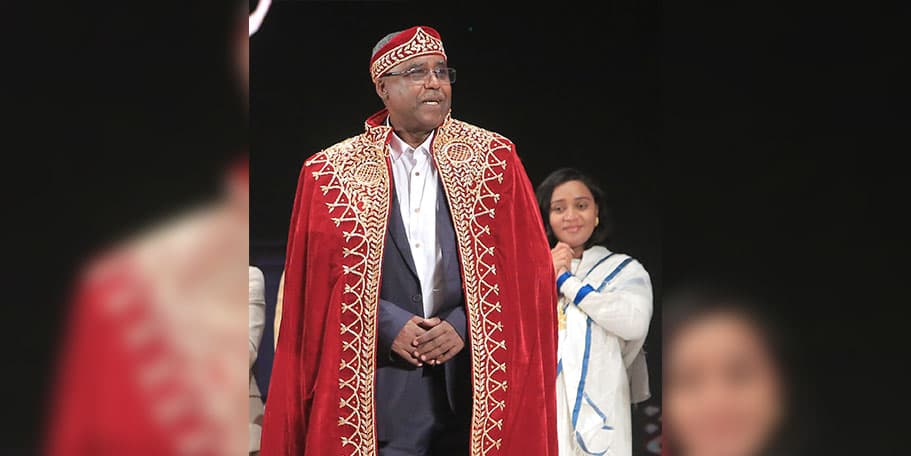
He entered the theatre not as a director, not as a playwright, but as a man being celebrated by the house he had served for more than four decades.
Abyssinia Bank presented him with a five-million-birr award. Habesha Beer gifted him a new BYD vehicle, and a soon-to-open bank branch in Seferene Selam, Bahir Dar, was named after him. The National Theatre wrapped him in a traditional kaba—a symbolic gesture.
But the truest recognition came not from institutions, but from human voices—voices of those who had walked with him, laughed with him, learned from him, or simply watched him work.
“I am very fortunate—God loves me abundantly. None of this happened by my will,” he told the audience, overcome with emotion. “God cleared my path long ago and placed me at this pillar of honor.” Tears pooled in his eyes. He wiped them away. The hall held its breath.
Among the speakers was Tesfaye Sima, lead actor in Ha Hu or Pe Pu and Wuchale 17. He did not speak of scripts or technique, but of joy.
“He jokes until your stomach hurts, until tears of laughter fall and your cheeks burn,” Tesfaye said.
It is an image that contrasts with the composed artist audiences recognized on stage. Yet that is the real Getnet—the man who could turn exhaustion into comedy, tension into relief.
Artists often speak of generosity as a virtue. For Getnet, generosity was simply muscle memory.
Even artists abroad sent messages—Meron Getnet, Alem Tsehay Wedajo, Tamagne Beyene, Tekle Desta, Alemayehu Gebre Hiwot, Yetnnesh Abebe. All echoed one sentiment: that he shaped them, shaped the field, and that through him entire artistic lineages were born.
“Through Getnet, great artists were created,” said Nebiyu Baye, State Minister for Culture and Sport. “He is one of Ethiopia’s artistic treasures.”
Every great artist has a defining anecdote. For Getnet, it could be the plays, the poems, the international tours—the twelve back-to-back shows in the United States where Ethiopian audiences packed theatres until midnight, all within a single month.
But perhaps the truest story is still the one Meaza tells—the trembling student, the unexpected welcome, the door disguised as a wall.
“He was the one who first took my hand and introduced me to the National Theatre—with the generosity of a father,” she says. “Honoring him is honoring his profession, honoring the National Theatre, and honoring all of us.”
Theatre is an ephemeral medium. It vanishes the moment the applause fades, leaving behind only memory. But some performances linger, not because of the stage, but because of the human being behind them.
Getnet is one of those rare figures whose greatness is measured not only by output, but by impact—on the art, on the artists, on the quiet young people he encouraged without realizing it, and on the history he helped write with his own hands.
Today, the National Theatre still carries the echo of his footsteps. The door he once opened for a frightened student remains, blending almost invisibly into the wall. New actors rehearse on the same boards where his words once came alive. New writers study his scripts, tracing where he paused, where he broke a sentence for breath, where he tucked away a truth too delicate for direct speech.
There are artists in Ethiopia who may never meet him, yet who owe their artistic lineage to the space he made possible.
He is 68 now, though age seems reluctant to claim him. The brightness in Meaza’s story—the smile on the staircase—still remains. The generosity of that moment has only grown.
To recount his achievements is to trace the map of a life lived in devotion—to craft, to people, to the fragile power of stories.
In the end, the art he created may or may not endure; But the door he opened—quietly, gently, disguised as a wall—remains. Still there. Still open. Still guiding the next trembling student into the world of Ethiopian theatre.
(Abebe Fikir has contributed to this article.)
Comments
No comments yet. Be the first to leave a comment!
Leave a Comment
Society
Old Jaffa, New Tel Aviv
November 22, 2025

Society
“Now, It’s My Land”: Legal Reform Transforms Women’s Ownership in Rural Ethiopia
November 15, 2025

Society
A Gift of Technology — and Hope — for Koye’s Students
November 08, 2025
Society
Data for a Changing Climate: From Soil to Strategy
November 01, 2025

Society
Harnessing Data, Driving Innovation: Securing East Africa’s Water Future
October 25, 2025
Society
Bridging the Health Gap: Ethiopia’s push for Equitable Health
October 18, 2025
Art
Blending traditions: A taste of Italy, Crafted with Ethiopian ingredients
December 06, 2025
Art
Between Tradition and Trend: Ethiopia’s Musical Identity in the Modern Era
November 29, 2025
Art
Ethiopia’s Living Heritage in the Holy Land
November 22, 2025
Art
The Door that Never Closed: Honoring Getnet Enyew
November 15, 2025
Art
Echoes of Memory
November 01, 2025

Art
December 06, 2025
Blending traditions: A taste of Italy, Crafted with Ethiopian ingredients

Art
November 29, 2025
Between Tradition and Trend: Ethiopia’s Musical Identity in the Modern Era

Art
November 22, 2025
Ethiopia’s Living Heritage in the Holy Land

Art
November 15, 2025
The Door that Never Closed: Honoring Getnet Enyew

Art
November 01, 2025
Echoes of Memory
Art
October 25, 2025
A Softer Pulse: Where Addis Rediscovers Its Quiet Rhythm

Art
October 18, 2025
A Fusion of Innovation and Art

Art
October 11, 2025
From Bahir Dar to Hollywood: Elisabeth Adame’s Cinematic Journey