Society
November 15, 2025
“Now, It’s My Land”: Legal Reform Transforms Women’s Ownership in Rural Ethiopia




By
Abraham Tekle
In the East Showa Zone of Ethiopia’s Oromia region, Workenesh Bulbula, 50, sits beneath the soft shade of an acacia tree, reflecting on a decision that has haunted her for years.
“I regret the decision I made back then,” she says quietly. Years ago, Workenesh left her family’s farmland near Mojo town to seek a new life in the city—a move she once believed would offer freedom and opportunity. Instead, she found herself disconnected from the land that had sustained generations before her.
Two years ago, everything changed. The government’s political reforms and the passage of a new Rural Land Administration and Use Proclamation altered not only Ethiopia’s land governance but also Workenesh’s life. The acre of farmland she inherited from her father—once just a fading memory—has become the foundation of her renewed independence.
“Thanks to the new law, my life has completely changed,” she told The Reporter. “It gives me full rights to manage my land and use it as I wish.”
Before the reforms, women like Workenesh were often limited to joint ownership through marriage. Legally, their names appeared on land certificates—but in practice, few had control over how their land was used or how the income was spent.
“Before, we didn’t even know what was planted on the land, how much it produced, or how the money was used,” she recalls. “Men made all the decisions.”
That dynamic, she says, is beginning to shift. “Women now have equal rights to own and manage land, to decide what to plant, and to share profits equally with their husbands. We even use the land as collateral to start other businesses.”
With full legal ownership of the farmland she shares with her siblings, Workenesh now divides her time between small-scale farming and leasing her land to tenants. “Last year, my tenant harvested 80 quintals of wheat and chickpeas from one acre,” she says, smiling. “We split the harvest evenly.”
Her story mirrors a broader transformation across rural Ethiopia. The Proclamation—the latest in a series of legal reforms—aims to strengthen women’s rights to own, manage, and inherit land. Once largely symbolic, those rights are now being exercised in ways that are reshaping local economies and gender relations alike.
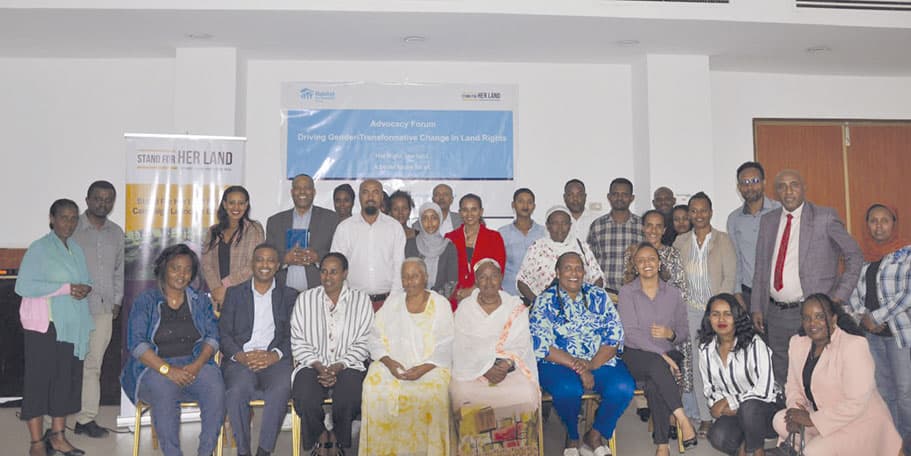
The wider impact of these reforms came into focus at a recent workshop held at Getfam Hotel, organized by Habitat for Humanity Ethiopia in collaboration with Landesa and funded by BMZ. The forum, titled “Advocacy Forum on Women’s Land Rights,” brought together government officials, and land-rights advocates to discuss the gender-transformative aspects of the revised law at both federal and regional levels.
Organizers said the gathering offered a crucial space to assess how the new legal framework is changing women’s lives—and to confront the challenges that remain in ensuring equal access, awareness, and enforcement.
The forum is part of the five-year Stand for Her Land (S4HL) initiative, a nationwide campaign advocating for women’s land rights across Ethiopia. In a country where cultural norms often determine who owns and controls land, the initiative seeks to challenge deeply rooted barriers that limit women’s access to property and decision-making power.
“We operate through a coalition of 25 member organizations focused on promoting gender equality and women’s rights,” said Eden Aserat, advocacy specialist at Habitat for Humanity Ethiopia. “Together, we’re working to make sure the legal provisions for women’s land rights become a lived reality.”
Eden underscored the importance of collaboration, describing partnerships as the cornerstone of progress. “Our key partners include grassroots women, religious and community leaders, the media, policymakers, international and local NGOs, community organizations, and self-help groups,” she told The Reporter. “The coalition aims to promote secure and equitable land rights through locally driven advocacy efforts.”
Signs of progress, she added, are already visible. “Currently, 80 percent of land ownership certificates issued across 31 parcels of land in Ethiopia list women’s names—either jointly or individually,” Eden said. “Raising community awareness and leveraging our coalition’s strength are essential for the effective implementation of the law, which is vital for improving women’s lives.”
At the same forum, Abebaw Abebe, a legal expert on land, discussed how the revised proclamation is transforming ownership patterns across regions such as Oromia, Sidama, and the southern and central parts of the country. The South-West Ethiopia Region, he noted, has already adopted the revised law, while Amhara is in the process of ratification. Other regions—including Afar, Somali, South Ethiopia, and Gambella—are drafting their versions. Only Tigray, still under interim administration, remains an exception.
According to Abebaw, the new proclamation grants women equal rights to land ownership, both jointly and individually, while expanding farmers’ land use rights. It enables them to obtain formal tenure certificates and use their holdings as collateral—changes that could “reshape rural livelihoods and the agricultural economy, significantly improving women’s lives,” he said. The previous law, he noted, had been “gender-blind,” effectively excluding women from full ownership.
Yet, Abebaw cautioned that the challenge now lies in implementation. “Weak enforcement continues to hinder progress toward equitable land ownership,” he said. “Collaboration is critical if the law’s promise is to be realized.”
That collaboration is already taking root at the local level through initiatives such as Ras-Agez, a coalition forum whose name means self-reliance in English. Working in partnership with legal experts, local authorities, and community organizations, the forum helps women navigate the complexities of the new land law and claim their rights.
Tigest Ejigu, chairperson of the Ras-Agez forum, said she and her colleagues have undergone basic training in human rights and land administration law—knowledge they now use to educate and empower others. “We encourage women to understand their rights and make independent decisions about their assets,” she said.
The forum also acts as a support network for those facing unlawful dispossession. “We show them where to go, what to do, and how to reclaim their land under the new law,” Tigest explained, crediting the revised legislation for much of their success.
Since its establishment, Ras-Agez has helped at least five women regain property that had been wrongfully taken from them. One of them, Tigest recalled, had been pressured by her husband’s family to relinquish her land. With their intervention and the backing of local authorities, she was able to reclaim full ownership.
Stories like hers and Workenesh’s reflect a growing shift: women asserting control over their livelihoods, challenging patriarchal norms, and reshaping the rural economy in the process.
For Habitat for Humanity Ethiopia, which has worked in the country since 1993, supporting this transformation is part of a broader mission. The organization, known for providing vulnerable families with access to housing, safe water, and sanitation, says its programs have reached more than 850,000 people in urban and semi-urban areas. Now, its work in land rights advocacy is helping ensure that the ground beneath women’s feet—literally—belongs to them.
Comments
No comments yet. Be the first to leave a comment!
Leave a Comment

Society
Old Jaffa, New Tel Aviv
November 22, 2025
Society
“Now, It’s My Land”: Legal Reform Transforms Women’s Ownership in Rural Ethiopia
November 15, 2025

Society
A Gift of Technology — and Hope — for Koye’s Students
November 08, 2025
Society
Data for a Changing Climate: From Soil to Strategy
November 01, 2025

Society
Harnessing Data, Driving Innovation: Securing East Africa’s Water Future
October 25, 2025
Society
Bridging the Health Gap: Ethiopia’s push for Equitable Health
October 18, 2025
Art
Blending traditions: A taste of Italy, Crafted with Ethiopian ingredients
December 06, 2025
Art
Between Tradition and Trend: Ethiopia’s Musical Identity in the Modern Era
November 29, 2025
Art
Ethiopia’s Living Heritage in the Holy Land
November 22, 2025
Art
The Door that Never Closed: Honoring Getnet Enyew
November 15, 2025
Art
Echoes of Memory
November 01, 2025
Society
November 22, 2025
Old Jaffa, New Tel Aviv
Society
November 15, 2025
“Now, It’s My Land”: Legal Reform Transforms Women’s Ownership in Rural Ethiopia
Society
November 08, 2025
A Gift of Technology — and Hope — for Koye’s Students
Society
November 01, 2025
Data for a Changing Climate: From Soil to Strategy
Society
October 25, 2025
Harnessing Data, Driving Innovation: Securing East Africa’s Water Future
Society
October 18, 2025
Bridging the Health Gap: Ethiopia’s push for Equitable Health

Society
October 18, 2025
Africa’s Ticking Clock: The Coming Cancer Crisis

Society
October 11, 2025
Smart Tech and Soft Loans: Financing innovation to Transform Ethiopia’s Smallholder Agriculture