Business
By Ashenafi Endale
December 06, 2025
Majority of FDI Projects Go Unrealized, Investment Commission Asleep at Wheel: Report
Less than 40 percent of foreign direct investment (FDI) projects registered over the last six years have gone operational, while many factories have been forced to cut or cease production owing to a lack of support, reveals a new report from the Anti-Corruption Commission. The Commission’s ‘FDI Licensing and Post-investment Implementation Systems’ covers six years leading up to 2025 and was published this month despite being finalized in the first half of the year. It indicates the Ethiopian Investment Commission (EIC) issued a total of 1,509 permits to foreign investors during the reporting period. However, only 586 investors (39 percent) have managed to start operations since receiving their permits, according to the report. Its authors criticized the EIC for failing to duly support investors. The report reveals the Commission responded to only a fifth of the 213 FDI-related complaints it received over the reporting period. Many of the complaints and requests for special support stemmed from security risks, according to the report. More than half (116) came from investors in Oromia, while 59 investors in the Amhara Regional State made appeals to the EIC. However, the Commission responded only to 48 of the appeals, according to the report. For instance, Emirates Steel Ethiopia PLC leased a plot in Gelan, Oromia, for a basic iron and steel manufacturing plant. However, the lack of a power line meant the company was unable to start production, and the Oromia regional administration eventually reclaimed the land. The report notes the Commission failed to resolve the issue despite repeated appeals from the UAE’s embassy in Addis Ababa. It reveals the manufacturer had paid electricity bills in advance. Another example is Saudi Agricultural Investment Co Ltd Ethiopia, which planned to build a manufacturing plant in Burayu, Oromia. The company paid lease and right of way compensations ten years ago but authorities denied it access to land, according to the report. As a result, it was forced to lease space in warehouses to store its equipment for years, incurring huge losses. The report highlights that while Ethiopia has attracted an average USD 3.3 billion in annual FDI over the six-year period, only 586 foreign-investor-backed projects valued at 281 billion Birr (around USD 1.8 billion at current exchange rates) have been able to get off the ground. It also indicates that while FDI-backed businesses managed to register USD 953 million in exports over the period, their performance has been declining for the last two years. Some of the FDI projects assessed by the Anti-Corruption Commission include Ayka Addis Textile and Investment Group PLC, and Saygen Dima Textile SC. In April 2020, the Council of Ministers opted to write off 2.1 billion Birr in unpaid taxes from Ayka Addis after the textile plant’s Turkish investors defaulted on loans they took from the state-owned Development Bank of Ethiopia (DBE) following years of reported losses. Ayka Addis also enjoyed 773 million Birr in tax breaks and failed to pay 112.5 million Birr towards its employees’ pensions. Similarly, the Council wrote off 28 million Birr in unpaid taxes for Saygon Dima, whose Turkish investors also failed to repay loans taken from DBE. The Ethiopian embassy in Ankara, the Foreign Ministry, EIC, and the bank are reportedly moving towards auctioning off the company. The report notes that 307 FDI permits remain valid despite remaining inoperational for more than two years, giving the Commission the right to revoke them. Not revoking the permits is illegal, according to the report, which accuses the Commission of renewing permits despite an evident lack of progress. The report alleges the Commission allowed foreign investors to skirt around the USD 200,000 minimum capital threshold, while others, such as the investors behind Ayka Addis and Saygon Dima, were permitted to access huge loans without collateral. The report criticizes EIC and the Customs Commission for lacking procedures to follow up on incentives offered to investors, leaving them open to abuse that can cost the government billions of Birr in revenue. The report highlights that EIC has failed to address forex shortages that have crippled manufacturers like Transsion Manufacturing PLC, domestic producers of Tecno mobile devices. The firm has been forced to shut down 12 of its 14 production lines due to a lack of forex to import inputs. While presenting quarterly report to the parliament few weeks ago, MPs urged officials of EIC including Commissioner Zeleke Temesgen, to address multiple challenges investors are facing. Led by Commissioner Samuel Urkato, the Federal Anti-Corruption Commission has recently produced reports across several sectors, seriously criticizing government institutions for the various types of corruption loopholes ending at loss of billions of public money, underperformances.
By Ashenafi Endale
December 06, 2025
Developing Countries’ Debt Service Payments Exceed Financial Inflow for First Time: World Bank
Ethiopia’s income status ‘unclassified’ in 2025 debt report For the first time in half a century, debt service expenditures by developing countries are exceeding the inflow of new financing, according to the World Bank’s 2025 International Debt Report. It reveals that between 2022 and 2024, about USD 741 billion more flowed out of developing economies in debt repayments and interest than flowed into them in the form of new financing. “It was the largest debt-related outflow in more than 50 years. The human toll has been steep: among the 22 most highly indebted countries, one out of every two people today cannot afford the minimum daily diet necessary for lasting health,” reads the new report. It indicates that in 2024, the total external debt stock of low- and middle-income countries (LMICs) hit a new record of USD 8.9 trillion, 1.2 trillion of which was owed by the 78 most vulnerable countries eligible to receive grants and low-cost loans from the World Bank’s International Development Association. These countries paid more than USD 415 billion in interest payments alone in 2024, according to the report. “These payments are 2.4 times higher than a decade ago, driven mainly by a 4.5 percent increase from public sector borrowers, to USD 161.3 billion. This increase in interest payments has had severe consequences in high-debt countries, where on average more than half the population is already unable to afford a healthy diet,” it reads. China, the largest debtor country among LMICs, accounted for 30.1 percent of LMICs’ interest payments on total debt stock, according to the report. In 2024, LMICs paid out USD 205 billion more in principal and interest than they received in new loans, marking the third consecutive year of net outflows, according to the World Bank. The report indicates that debt is now growing more slowly, and cited successful examples of debt restructuring in the cases of Ghana, Haiti, Somalia, and Sri Lanka. “Progress, of course, is occurring, but it is modest, and considerably more is needed. Debt burdens are now growing more slowly. Creditors were in a forgiving mood last year: they agreed to restructure USD 90 billion in developing country debt, more than at any time since 2010,” it reads. Elsewhere in the report, the World Bank notes that Ethiopia’s income classification is still in a temporary status of “unclassified” for fiscal year 2026. “The World Bank still considers Ethiopia an IDA-only country, so the terms and conditions of World Bank financing for the country have not changed. Agencies using the World Bank income classification to determine access conditions to their own resources should still consider Ethiopia a low-income country,” it reads. Ethiopia’s total external debt as at 2024 stood at USD 36.5 billion, up from USD 7.3 billion in 2010, and USD 30.6 billion in 2022, according to the WB report.
By Ashenafi Endale
December 06, 2025
M-PESA Calls Foul on Limited Access to New App
Vodacom Group to buy out Kenyan government’s 15pct stake in Safaricom Safaricom-affiliate M-PESA Ethiopia has lodged complaints with the authorities, alleging that its new financial services app has been disabled by state-owned operator Ethio telecom. M-PESA Lehulum, a telecom agnostic customer-centric financial services app that allows any Ethiopian to transact on Safaricom’s M-PESA mobile money platform, was launched on December 1. This mobile application can be downloaded from any telecommunication network and provides simple and secure access to digital financial services. The app is designed to work with any SIM card, without SIM and across any telecom platform. Onboarding is through Fayda National ID’s eKYC system. The app is a rival to Ethio telecom’s massive Telebirr platform, and observers say the state-owned operator is likely concerned that M-PESA might erode its customer base. A public statement issued by M-PESA on Friday December 5, 2025, reads “We would like to inform the public that M-PESA Lehulum is currently not accessible on smartphones using mobile data services managed by Ethio telecom, leaving our customers unable to log in, transact, or retrieve their funds.” The app is fully approved by the regulator, the National Bank of Ethiopia and INSA, according to the statement. M-PESA Ethiopia is a stand-alone legal entity duly registered in Ethiopia and holder of a payment instrument issuer license from the central bank. “We would like to confirm that our team is working diligently to maintain access to M-PESA Lehulum and restore full digital reachability as quickly as possible. We are actively engaging with regulators to resolve the matter urgently and remain committed to protecting your freedom of choice as well as ensuring uninterrupted access to the digital and financial tools that you rely on,” reads the statement. The Ethiopian Communications Authority, Ethio telecom, and the NBE have yet to issue an official response to the statement. M-PESA’s troubles come following a September report from the World Bank highlighting unfair practices in the Ethiopian telecom sector and accusing Ethio telecom of undercutting the competition. The app’s launch also coincides with news that Vodacom Group Limited is buying out the Kenyan government’s 15 percent ownership stake in Safaricom for a reported USD 1.6 billion.
By Ashenafi Endale
November 29, 2025
Belated Financial Report Unravels Scope of Sugar Industry Group’s Woes
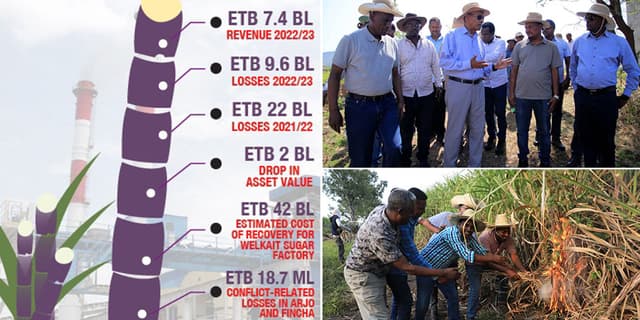
An overdue audit report highlights the continued struggles of the state-owned Ethiopian Sugar Industry Group (ESIG) and more than a dozen of its sugar estates scattered across the country, as years of mismanagement and security issues sustain the Group’s poor financial performance and risk the fate of Ethiopia’s sugar production ambitions. An audited financial report of the Group’s performance for the 2022/23 fiscal year was published this month, following more than two years of delays. The state-run Audit Service Corporation reports the Group, which at the time was run by long-serving CEO Weyo Roba and chaired by Girma Birru, saw its revenues drop by more than 13 percent to 7.4 billion Birr year-on-year. The Group’s comprehensive losses totaled 9.6 billion Birr during the reporting period, significantly lower than the 22 billion Birr registered the year prior but indicative of its ongoing troubles. Its forex losses also dropped by nearly 12 billion Birr to 3.6 billion Birr, while operating losses eased to 3.8 billion Birr from 15.7 billion. However, despite the declining losses, the Group reported a two billion Birr drop in total asset value, while cash and cash equivalents on hand dwindled from four billion Birr to 1.5 billion. The report outlines the dire financial status of the Group, which came into being in 2022 as part of a restructuring of the former Ethiopian Sugar Corporation that was established in 2010 in place of the Ethiopian Sugar Development Agency. More than a decade ago, the Corporation embarked on a campaign to launch new sugar estates and upgrade existing ones like Wonji Shoa, Finchaa, four in Omo Kuraz, Welkayit and the two Tana Beles estates in the Amhara region. At present, ESIG operates eight major sugar estates, five of which operate independently as subsidiaries. These include Wonji Shoa, Metehara, Fincha, Kessem, and Tana Beles. The remaining three—Arjo Didessa, Omo Kuraz II and Omo Kuraz III—are still under the direct control of the Group. Overall, ESIG administers around 86,355 hectares of sugarcane plantations, with estimated annual production of 600,000 tons of sugar, of which between 325,000 and 400,000 tons is consumed domestically. Additionally, ESIG oversees several sugar plants that are under construction or non-operational, including Omo Kuraz I and V, Welkait and Tendaho, all of which are managed as branches until completion or restructuring. The Group has ambitions to meet national sugar demand by 2028, targeting nearly 730,000 tons annually by 2026/7, but the report published this month indicates these ambitions are unlikely to be realized. When ESIG was established in 2022, its paid-up capital was reported to be 115 billion Birr, but later inquiries uncovered a deficit of 10 billion Birr. The Group’s board of directors decided in September 2025 to officially shrink the capital to 105 billion Birr in light of the deficit, and adjusted its authorized capital down by 30 billion Birr to 420 billion Birr. The adjustments were approved by Ethiopian Investment Holdings (EIH), which oversees the Group. This month’s audited financial reports reveal the Group’s sales of imported sugar, which makes up a large portion of its revenue, almost halved to 1.3 billion Birr in 2022/23. Sales of locally produced white sugar also dropped by 17 percent to five billion Birr, while molasses sales doubled from 231 million to 484 million Birr. The report indicates the flagship Wonji-Shoa sugar factory holds a long outstanding construction-in-progress balance of 2.2 billion Birr, primarily related to development and civil and irrigation works on outgrowers’ land. <img decoding="async" class="alignnone size-full wp-image-47955" src="https://www.thereporterethiopia.com/wp-content/uploads/2025/11/BELATED.jpg" alt="Belated Financial Report Unravels Scope of Sugar Industry Group’s Woes | The Reporter | #1 Latest Ethiopian News Today" width="911" height="456" title="Belated Financial Report Unravels Scope of Sugar Industry Group’s Woes | The Reporter | #1 Latest Ethiopian News Today" srcset="https://www.thereporterethiopia.com/wp-content/uploads/2025/11/BELATED.jpg 911w, https://www.thereporterethiopia.com/wp-content/uploads/2025/11/BELATED-300x150.jpg 300w, https://www.thereporterethiopia.com/wp-content/uploads/2025/11/BELATED-705x353.jpg 705w, https://www.thereporterethiopia.com/wp-content/uploads/2025/11/BELATED-150x75.jpg 150w, https://www.thereporterethiopia.com/wp-content/uploads/2025/11/BELATED-768x384.jpg 768w, https://www.thereporterethiopia.com/wp-content/uploads/2025/11/BELATED-696x348.jpg 696w" sizes="(max-width: 911px) 100vw, 911px" /> But these assets remain uncapitalised due to the termination of contracts by the majority of outgrowers, according to the report. Moreover, an impairment of 434 million Birr was recorded for advances and prepayments to outgrowers, a significant portion of which pertains to sugarcane plantations damaged during the political unrest of 2017 and to farms that unilaterally terminated their agreements with the factory. As these balances involve public funds and remain unsettled, management needs to re-engage the contractual agreements with the outgrowers, and recover outstanding advance payment, auditors urge. The auditor identified significant deficiencies in the internal control of intercompany receivables and payables in the Group, resulting in accumulated unreconciled inter-branch balances of 1.5 billion Birr. Differences remain between subsidiaries and the Group, as well as branches and the Group, according to the report. The residual balance was changed to accumulated losses without appropriately reflecting the economic substance of the transactions, resulting in accumulated loss of 1.5 billion Birr, it reads. A receivables balance of 1.47 billion Birr is recorded under the Sugar Industry Development Fund (SIDF), for which no supporting evidence was provided. The report notes inconsistent inventory methods are deployed across the Group’s estates, and identifies a 98 million Birr deficit between physical inventory count and the ledger balances at the Group’s factories and head office project unit. A further discrepancy of 166 million Birr was noted at the head office between sugar ledger and physical count sheets. This difference remained unresolved, resulting in a continued overstatement of inventory. Moreover, the Group holds long outstanding goods in transit totaling 523 million Birr, including letters of credit (LCs) issued beyond contractual terms that remain unclear, according to the report. Auditors say sugar estates lack an effective mechanism for allocating overhead and production costs, leaving them unable to place reliance on the 4.7 billion Birr in reported cost of sales. They also found trade and other payables totalling 7.4 billion Birr, including 1.2 billion Birr in long-outstanding balances. Advance payments to contractors totaled 14 billion Birr, of which nearly 60 percent is impaired, according to the report. This high level of impairment reflects significant deficiency in internal control over monitoring and recovery of advance payments, auditors caution, urging the Group to take legal and administrative measures to ensure accountability and recovery. While factory operations declined, the cost of goods production stood at 4.7 billion Birr. Salary and benefits took up nearly one billion Birr, according to the report. The report also reveals the extent of the impacts of conflict and insecurity on the Group’s operations and margins. It details opaque withdrawals of nearly 50 million Birr from bank accounts associated with the Welkait Sugar Factory during the two-year northern war. Military operations in Oromia posed significant problems for the operations of the Arjo and Fincha estates, according to the report. Arjo incurred losses of 10.4 million Birr due looting and property damage, while Fincha lost 8.3 million, according to auditors. A confluence of weather- and conflict-related factors continue to pose significant challenges in Tendaho. Management has been unable to gain access to the sugar estate to verify losses owed to theft or misappropriation, according to the report. As of June 2022, Tendaho’s property, plant and equipment carrying a value of 19 billion Birr remain exposed to risks. Following partial assessments, management recognized impairment losses of four billion Birr, according to auditors. The Welkait sugar factory has also experienced looting and destruction of property, according to the report. In light of inability to access the site, management ceased depreciation and recognized an impairment loss equivalent to book value of 112 million Birr, auditors revealed. Meanwhile, the audited report indicates that interest expenses alone on loans the Group took from the state-owned Commercial Bank of Ethiopia (CBE) and foreign banks stood at five billion Birr in 2022/23. All debt owed by the Group to the CBE has been transferred to the state-run Liability Asset Management Corporation (LAMC) and the Ministry of Finance over the past few years. In 2022, 102 billion Birr in outstanding debt was transferred to LAMC, with another 25 billion Birr owed to Chinese creditors was transferred to the Ministry’s books the following year. The report reveals that provisions for legal claims arising from litigations of labor cases, contractual and extra contractual liability and property damage claims stood at 1.3 billion Birr in June 2023, up from 759 million Birr the year prior. Contingent liabilities are also held, as there are a number of legal cases pending. One significant case involves Amibara Agricultural Development PLC. The firm entered an agreement to supply sugarcane to Kessem sugar factory and later filed a claim for 1.2 billion Birr, alleging damage and losses related to sugarcane that was either spoiled or left unutilized, according to the report. ESIG disputed the claim, asserting the loss did not result from negligence or contractual breach. The Federal High Court ruled in favor of ESIG, however, Amibara appealed and the case is currently under review. A number of projects under the Group remain suspended. The estate in Welkait reportedly requires a minimum of 42 billion Birr to recover from the impacts of the northern conflict, an amount Group executives are looking to cover through bank loans. Tendaho was also affected by the conflict, while the termination of most of its staff has raised uncertainty about the continued existence of the estate. Omo Kuraz I has been at a standstill despite construction on the project progressing to 83 percent, according to the report. The estate has been in limbo since the contract with the former Metals and Engineering Corporation (MetEC) was voided in 2018. The Group’s management is weighing its options, which include privatising a few or all of the sugar estates it operates. However, the government’s repeated efforts to sell off its stake in the troubled sugar industry have failed time and again. Earlier this month, the executives of EIH presented a quarterly performance report to Parliament in which they characterized the Group as one of four state-owned enterprises (SOEs) determined to be in “critical condition.” Meleket Sahlu, deputy CEO of EIH, told lawmakers that efforts to privatize eight sugar estates under the Sugar Industry Group have halted after a number of tenders failed to attract sound offers from bidders, even under direct negotiations.
By Nardos Yoseph
November 29, 2025
Ethiopia Ready to Gamble on Sustainable Aviation Fuel
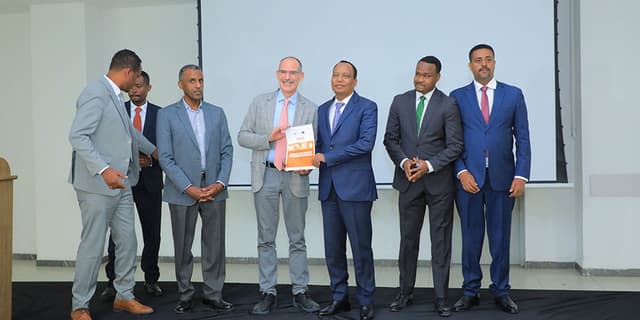
Ethiopia has formally begun positioning itself as a producer of sustainable aviation fuel (SAF) following the conclusion of a national feasibility study which confirmed that the country has both the land and renewable energy capacity for supplying the emerging global aviation fuel market. During a multi-stakeholder validation workshop held in Addis Ababa’s Skylight Hotel on Thursday November 27, experts presenting the feasibility study told officials and industry representatives that Ethiopia could produce low-carbon aviation fuel using local agricultural crops, municipal waste, sugar byproducts and renewable energy sources. The findings were presented to senior representatives from the ministries of Transport and Logistics, Agriculture, the Civil Aviation Authority, universities and private investors during a final validation workshop attended by international consultants and donors, including the European Union, which funded the study through the International Civil Aviation Organization (ICAO) The feasibility study launched in December 2024 with a national workshop and followed by field consultations and a March 2025 stakeholder conference, where Ethiopian officials engaged with technical experts to review data and evaluate business readiness for domestic SAF production. The research built on three previous studies including a 2019 WWF-South Africa assessment and two Ethiopian roadmap and feasibility studies conducted in 2021 and 2022, which first identified Ethiopian mustard as a viable aviation fuel crop. Lead consultant John McKechnie stated that Ethiopia was selected for deeper analysis because of its agricultural base, expanding industrial capacity and unexploited renewable energy resources, which together position the country strategically in Africa’s energy transition. Researchers confirmed that more than 30 million hectares of Ethiopian land are suitable for cultivating Ethiopian mustard without interfering with food production, making it one of the most promising non-food crops identified for sustainable aviation fuel feedstock. Field trials already show the crop can be produced at scale, though further research is required to determine how national production can be expanded to serve commercial aviation demand. Officials acknowledged challenges related to logistics and supply chains, noting that Ethiopia’s farmers are geographically dispersed and current transport infrastructure makes bulk feedstock collection difficult. The study examined multiple production routes including alcohol-to-jet fuel derived from sugar molasses, waste-to-fuel systems using municipal landfill material, and electricity-based fuels derived from renewable sources. Ethiopia’s sugar sector already has an annual ethanol production capacity of approximately 32.5 million liters, though current output remains constrained due to competition from food and beverage manufacturers willing to pay higher prices. Municipal waste presented a dual opportunity allowing the country to simultaneously address urban waste problems while generating clean aviation fuel, according to the technical team. Electricity-based fuel production was identified as one of Ethiopia’s strongest long-term options due to its high renewable energy potential, offering a future route for hydrogen-based synthetic fuel manufacturing. Power-to-liquid technology is projected to be certified between mid-2026 and late-2026, placing Ethiopia within range of early commercial adoption provided investment mobilization begins promptly. Consultants acknowledged current market prices for sustainable aviation fuel are roughly double conventional jet fuel rates, though they expect long-term costs to fall once production maturity is achieved. An international benchmark drawn from India revealed that mandatory aviation fuel blending will begin at one percent in 2027 and rise to five percent by 2030. Experts warned airlines that regulatory pressure will intensify across international airspace, with compliance becoming unavoidable by 2030 if Ethiopian carriers are to maintain global competitiveness. The government confirmed the formation of a national technical committee on sustainable aviation fuel and announced plans to establish a project office staffed by aviation and energy specialists in the coming weeks. Officials stated development partners would be invited to finance the project office and assist in converting research findings into industrial investment programs. Transport Ministry officials reiterated that aviation alone accounts for a large share of global emissions and that Ethiopia has committed to carbon-reduction targets under international climate agreements.
By Ashenafi Endale
November 22, 2025
Ethio telecom Reels from 70pct Dip in Profit after Tax
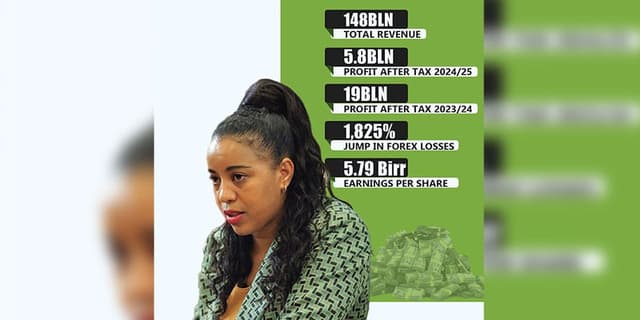
Currency float drove 1800pct jump in operator’s foreign exchange losses Ethio telecom saw its profit after tax plummet by nearly 70 percent to 5.8 billion Birr in the 2024/25 financial year as the government’s currency and forex market reforms took their toll on the state-owned enterprise. <img decoding="async" class="alignnone size-full wp-image-47855" src="https://www.thereporterethiopia.com/wp-content/uploads/2025/11/Ethio-telecom-Reels-from-70pct-Dip-in-Profit-after-Tax-1.jpg" alt="Ethio telecom Reels from 70pct Dip in Profit after Tax | The Reporter | #1 Latest Ethiopian News Today" width="911" height="456" title="Ethio telecom Reels from 70pct Dip in Profit after Tax | The Reporter | #1 Latest Ethiopian News Today" srcset="https://www.thereporterethiopia.com/wp-content/uploads/2025/11/Ethio-telecom-Reels-from-70pct-Dip-in-Profit-after-Tax-1.jpg 911w, https://www.thereporterethiopia.com/wp-content/uploads/2025/11/Ethio-telecom-Reels-from-70pct-Dip-in-Profit-after-Tax-1-300x150.jpg 300w, https://www.thereporterethiopia.com/wp-content/uploads/2025/11/Ethio-telecom-Reels-from-70pct-Dip-in-Profit-after-Tax-1-705x353.jpg 705w, https://www.thereporterethiopia.com/wp-content/uploads/2025/11/Ethio-telecom-Reels-from-70pct-Dip-in-Profit-after-Tax-1-150x75.jpg 150w, https://www.thereporterethiopia.com/wp-content/uploads/2025/11/Ethio-telecom-Reels-from-70pct-Dip-in-Profit-after-Tax-1-768x384.jpg 768w, https://www.thereporterethiopia.com/wp-content/uploads/2025/11/Ethio-telecom-Reels-from-70pct-Dip-in-Profit-after-Tax-1-696x348.jpg 696w" sizes="(max-width: 911px) 100vw, 911px" /> A financial statement audited by the Audit Service Corporation and signed by Ethio telecom chair and deputy PM Temesgen Tiruneh reveals the company’s drastic profit drop was largely driven by a 1,825 percent jump in foreign exchange losses tied to the government’s decision to float the currency in July 2024. “One of the macro reforms announced by Ethiopia’s government on July 29, 2024 was the foreign exchange rate is set by the market. This shift in the foreign exchange rate is noteworthy in comparison to the previous fixed exchange rate system. This resulted in a significant increase in the foreign exchange loss on outstanding debts and trade payables denominated in foreign currency. Foreign exchange loss has increased in 1,825 percent as compared to previous year,” reads the audited financial statement approved last month. The losses contrast with the optimistic outlook offered by CEO Frehiwot Tamiru during Ethio telecom’s annual performance review in July. The report indicates that forex losses jumped exponentially from three billion Birr in June 2024 to more than 42 billion Birr in June 2025. Behind the losses, which are likely among the largest in the enterprise’s history, lie the forex market reforms and subsequent currency depreciation. Today, commercial banks offer 155 Birr per USD, almost three times the rate at the time of floating, which was meant to boost exports and discourage imports. However, the move has also had the effects of limiting the government’s ability to service debt, raising the cost of imported commodities, and growing the debt burden of institutions who hold debt in foreign currency. Ethio telecom is among the institutions most affected by the Birr losing ground, and despite registering a 62 percent growth in revenue, forex losses have hurt its net profit. Ethio telecom still has external debts to service. Promissory notes owed to international telecom service providers are among the outstanding debts. The state-owned operator holds almost 30 billion Birr in total promissory notes payable on the balance, nearly double last year’s figure. Chinese tech giant Huawei accounts for the bulk of these notes at 21.5 billion Birr, while ZTE and Ericsson are owed the rest. The promissory notes arise from financing agreements with the vendors for the company’s next generation network and telecom expansion project (TEP), and most are due to be settled in 2028. The report indicates that Ethio telecom recorded 148 billion Birr in revenue, up from 91 billion Birr in June 2024. Profit before tax registered at 20 billion Birr. Ethio telecom’s total assets are valued at 331 billion Birr, up from 214 billion last year, according to the report. This year also saw Ethio telecom make an initial public offering. The company registered 100 million ordinary shares with the Ethiopian Capital Market Authority (ECMA) in late 2024. The number of shares sold during the IPO period from October 2024 to February 2025 was only a little over 10.6 million. A total of 47,377 investors bought the shares, at 300 Birr per share. The currency floating and the ensuing forex losses have cut into returns for the year, as earnings per share stood at 5.79 Birr per share, much lower than returns from investment in the banking sector. Ethio telecom’s employee benefits and salary expenses for its workforce of over 16,300 stood at nearly 16 billion Birr, up 1.5 billion from last year. The firm spent three billion Birr on advertisements and publicity, according to the report. News of Ethio telecom’s falling profits comes as its only competitor, Safaricom Ethiopia, announces an improved performance its executives hope will see the firm break even on its investments some time in 2027.
By Tsion Tadesse
November 15, 2025
Swedish Firms Eager to Board Bishoftu Airport Megaproject
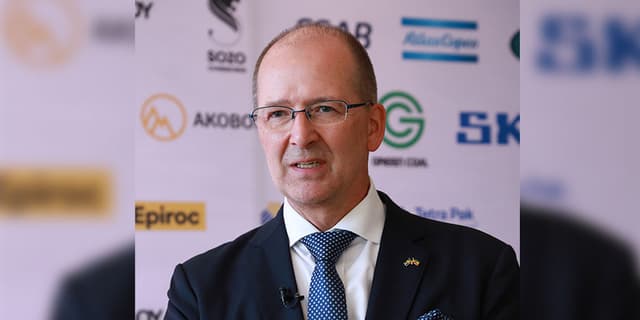
A number of businesses based in Sweden have expressed interest in getting involved in the USD 10 billion airport megaproject that Ethiopian government officials and Ethiopian Airlines executives foresee serving 100 million passengers annually by 2040. The airport, set to be constructed near Bishoftu, 40 kilometers south of Addis Ababa, was a central topic of discussion during the Ethio-Sweden Business Event organized by the Swedish embassy this week. Madeleine Martinelle, head of the Swedish Trade and Investment Council’s Kenya office, told The Reporter that five Swedish firms have expressed interest in joining the project and that she expects more to follow. The firms that have already shown their interest are primarily engaged in construction, mechanical repair, and air traffic control, according to Martinelle. However, she says these businesses need to learn more about the project details and their potential roles before committing to the work. “Although the businesses have expressed interest, they will need time to review financial and other details before moving on to the next step,” said Martinelle. Also in attendance during Wednesday’s forum opening at the Sheraton Addis hotel was Swedish Ambassador to Ethiopia Magnus Lennartsson, who also highlighted the growing interest and spoke about Sweden’s century-long business ties with Ethiopia and the contributions of the Scandinavian nation’s large Ethiopian diaspora community. Construction on the airport, slated to replace Addis Ababa’s Bole International as Ethiopian Airlines’ operational hub, has yet to begin. In August, Prime Minister Abiy Ahmed (PhD) and the then African Development Bank (AfDB) president Akinwumi Adesina signed a formal financing agreement that put AfDB in charge of efforts to raise close to USD eight billion in financing to back the megaproject. The Ethiopian Airlines Group is expected to provide 20 percent of the expected USD 10 billion cost, while officials are hoping lenders will cover the remaining 80 percent. That month, a report from the Ministry of Finance estimated the cost of resettling the residents of Abusera, the site where the airport is set to be erected, at upwards of USD 350 million.
By Nardos Yoseph
November 08, 2025
Regulators Seek to Bar Sub-Investment-Grade Banks from Entering Ethiopian Market
Foreign banks seeking to operate through subsidiaries in Ethiopia will be admitted only if they hold an investment grade credit rating of at least BBB- or its equivalent, according to a directive in the making at the National Bank of Ethiopia (NBE). The draft ‘Requirements for Licensing and Renewal of Banking Business and Representative Office Directive’ seeks to set entry standards for foreign entrants and marks the first time that Ethiopia has made an external credit-rating threshold a statutory prerequisite for market access. The draft requires any foreign bank wishing to establish a subsidiary, branch or representative office to submit a formal “no-objection letter” from its home supervisory authority directly to the NBE. An assurance from the Bank’s home supervisory authority is also expected to confirm the applicant is in good financial standing, maintains the home supervisor’s risk management standards, meets prudential requirements and has been rated investment grade, “that is, at least BBB- or BAA or equivalent, by rating agencies such as Standard & Poor’s, Fitch or Moody’s.” Regulators require applicants to present reports on the amount, composition, and geographical distribution of capital, while would-be entrants will also need to disclose if they have previously had an application to conduct banking operations in another country rejected. Under the same provision, the home regulator’s letter must also confirm that the applying bank is supervised on a consolidated basis and complies with Basel capital and liquidity standards. Besides the credit-rating criteria, the draft directive also obliges all foreign bank subsidiaries to maintain a minimum paid-up capital of five billion Birr, fully remitted in acceptable foreign currency and deposited in a blocked account prior to licensing. Applicants must disclose source of funds for the minimum capital, according to the draft. On the other hand, the directive stipulates that before a license is granted, the NBE and the home supervisor must sign a Memorandum of Understanding covering information sharing, joint supervision and crisis-management cooperation. It also states that if the proposed foreign bank subsidiary is of significance to the foreign bank, a supervisory college shall be established between the home supervisor and the National Bank to ensure a common and aligned work program and harmonized supervisory decisions. While the investment-grade clause screens for external soundness, ownership and governance provisions impose internal safeguards. Aggregate foreign ownership in a domestic bank is capped at 49 percent, with a single strategic investor limited to 40 percent, a juridical person to 10 percent, and a natural person to seven percent of total subscribed shares Every prospective director and chief executive officer must pass the NBE’s fit-and-proper test supported by recent tax and criminal-clearance certificates, while at least one-third of board members of a foreign bank subsidiary must be Ethiopian nationals. The draft directive states that the central bank will decide on a banking business license within 90 days of the last date of receipt. However, this time frame excludes any waiting time spent by the applicant in attending to queries raised by the NBE in addressing such queries, according to the draft. An applicant will have a full year to begin operations after receiving approval from the NBE. Regulators say the directive aims to “promote a strong and viable banking sector in Ethiopia” and “ensure safety and soundness of the banking system” through proper licensing and supervision.

By Nardos Yoseph
November 08, 2025
Allied Gold’s Capital Expenditures Pile Up as Execs Eye Production in 2026
Ethiopian Electric Power slated to finalize transmission line in coming months Allied Gold Corporation poured more than USD 187 million in capital expenditures into the Kurmuk gold mining project in Benishangul-Gumuz in the nine months leading up to October 2025, according to a document filed with the US Securities and Exchange Commission. Allied Gold holds three gold exploration licenses in Benishangul through its subsidiary Kurmuk Gold Mining PLC (KGM) and its executives say they will begin gold production in mid-2026, almost a decade after the firm acquired the concessions. Before the acquisition in 2018, the Kurmuk gold project was under Asec Company for Mining (ASCOM), a conglomerate with strong ties to the Egyptian government. KGM holds a 20-year concession for gold mining in a 100 square kilometer plot covering the Dish Mountain and Ashashire deposits, with gold exploration licenses covering an additional 1,450 square kilometers in Benishangul, according to a prospectus presented to investors in 2023. However, the firm has been unable to commence gold production over the past several years owing to a number of issues. In July 2024, the company penned a letter to the Ministry of Mines complaining that its operations in the gold-rich Benishangul-Gumuz Regional State were being hindered by regional authorities, whom it accused of refusing the company access to mining sites. The firm accused the Benishangul-Gumuz Water, Mine, and Energy Resource Development Bureau of refusing to endorse the exploration licenses granted to KGM by the Ministry. An investigation by The Reporter found that regional officials were pushing back against KGM’s concessions due to questions surrounding “the legitimacy of the licensing process” and concerns about what it would mean for a large number of artisanal miners who depend on the land allotted to KGM to make a living. The issues seem to have cleared up, and Allied Gold reports that engineering works have been substantially completed, and construction has entered the mechanical erection, earthworks, and power-line installation phase. The state-owned Ethiopian Electric Power (EEP) is scheduled to finalize a transmission line to the mining site in early 2026, ahead of commissioning in the second quarter, according to the document filed with US regulators. “The key focus during the quarter and the rest of the year is on logistics for transporting equipment and materials to the site, finishing technical concrete works around the grinding area, and advancing the mechanical erection at the processing plant site,” it reads. Allied is banking on producing 290,000 ounces of gold annually in Kurmuk, according to the document. The project, which Allied describes as “a key growth asset within its African portfolio,” is designed to become a cornerstone mine as the company targets group-wide production of over 800,000 ounces by 2029. Allied also operates gold mines in Mali and Côte d’Ivoire. Analysts who spoke to The Reporter contend that Kurmuk has the potential to transform Ethiopia’s gold-export base and attract renewed investor confidence in the mining sector. The project, located about 700 kilometers west of Addis Ababa, is also expected to generate significant local employment and fiscal revenues through royalties and taxes once commercial production begins. Industry observers caution, however, that the project’s success depends on stable power supply, regulatory coordination, and security in the Benishangul-Gumuz region. Previous investor reports have underscored potential sensitivities given the mine’s proximity to the Grand Ethiopian Renaissance Dam (GERD) and past joint-venture ties involving Egyptian interests, which Allied Gold has since been consolidating through staged buyouts. In October 2024, Kurmuk Gold transferred 5.75 million shares to ASCOM Precious Metals Investment Holding BVI, a subsidiary of the Egyptian Asec Company for Mining (ASCOM). ASCOM, an Egyptian conglomerate affiliated with the government in Cairo, had previously run the Kurmuk project for a decade beginning in 2007 before its license was revoked over security concerns. The license was transferred to Allied Gold Corp in 2017. ASCOM exited the venture in Benishangul by selling 64 percent of its stakes to Allied while retaining 35 percent through its subsidiary, ASCOM Precious Metals (APM). It later announced that it had sold the remainder of its shares. The Ethiopian government is entitled to a seven percent stake in the venture in exchange for infrastructural support, including roads and power supply.