Business
November 22, 2025
Ethio telecom Reels from 70pct Dip in Profit after Tax




By
Ashenafi Endale
Currency float drove 1800pct jump in operator’s foreign exchange losses
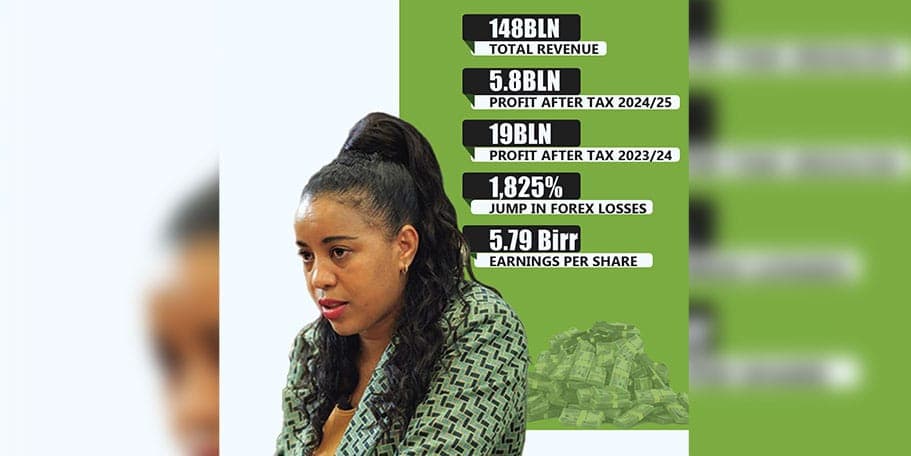
Ethio telecom saw its profit after tax plummet by nearly 70 percent to 5.8 billion Birr in the 2024/25 financial year as the government’s currency and forex market reforms took their toll on the state-owned enterprise.
A financial statement audited by the Audit Service Corporation and signed by Ethio telecom chair and deputy PM Temesgen Tiruneh reveals the company’s drastic profit drop was largely driven by a 1,825 percent jump in foreign exchange losses tied to the government’s decision to float the currency in July 2024.
“One of the macro reforms announced by Ethiopia’s government on July 29, 2024 was the foreign exchange rate is set by the market. This shift in the foreign exchange rate is noteworthy in comparison to the previous fixed exchange rate system. This resulted in a significant increase in the foreign exchange loss on outstanding debts and trade payables denominated in foreign currency. Foreign exchange loss has increased in 1,825 percent as compared to previous year,” reads the audited financial statement approved last month.
The losses contrast with the optimistic outlook offered by CEO Frehiwot Tamiru during Ethio telecom’s annual performance review in July.
The report indicates that forex losses jumped exponentially from three billion Birr in June 2024 to more than 42 billion Birr in June 2025. Behind the losses, which are likely among the largest in the enterprise’s history, lie the forex market reforms and subsequent currency depreciation.
Today, commercial banks offer 155 Birr per USD, almost three times the rate at the time of floating, which was meant to boost exports and discourage imports. However, the move has also had the effects of limiting the government’s ability to service debt, raising the cost of imported commodities, and growing the debt burden of institutions who hold debt in foreign currency.
Ethio telecom is among the institutions most affected by the Birr losing ground, and despite registering a 62 percent growth in revenue, forex losses have hurt its net profit.
Ethio telecom still has external debts to service. Promissory notes owed to international telecom service providers are among the outstanding debts. The state-owned operator holds almost 30 billion Birr in total promissory notes payable on the balance, nearly double last year’s figure.
Chinese tech giant Huawei accounts for the bulk of these notes at 21.5 billion Birr, while ZTE and Ericsson are owed the rest.
The promissory notes arise from financing agreements with the vendors for the company’s next generation network and telecom expansion project (TEP), and most are due to be settled in 2028.
The report indicates that Ethio telecom recorded 148 billion Birr in revenue, up from 91 billion Birr in June 2024. Profit before tax registered at 20 billion Birr.
Ethio telecom’s total assets are valued at 331 billion Birr, up from 214 billion last year, according to the report.
This year also saw Ethio telecom make an initial public offering. The company registered 100 million ordinary shares with the Ethiopian Capital Market Authority (ECMA) in late 2024.
The number of shares sold during the IPO period from October 2024 to February 2025 was only a little over 10.6 million. A total of 47,377 investors bought the shares, at 300 Birr per share.
The currency floating and the ensuing forex losses have cut into returns for the year, as earnings per share stood at 5.79 Birr per share, much lower than returns from investment in the banking sector.
Ethio telecom’s employee benefits and salary expenses for its workforce of over 16,300 stood at nearly 16 billion Birr, up 1.5 billion from last year. The firm spent three billion Birr on advertisements and publicity, according to the report.
News of Ethio telecom’s falling profits comes as its only competitor, Safaricom Ethiopia, announces an improved performance its executives hope will see the firm break even on its investments some time in 2027.
Comments
No comments yet. Be the first to leave a comment!
Leave a Comment

Society
Old Jaffa, New Tel Aviv
November 22, 2025

Society
“Now, It’s My Land”: Legal Reform Transforms Women’s Ownership in Rural Ethiopia
November 15, 2025

Society
A Gift of Technology — and Hope — for Koye’s Students
November 08, 2025

Society
Data for a Changing Climate: From Soil to Strategy
November 01, 2025

Society
Harnessing Data, Driving Innovation: Securing East Africa’s Water Future
October 25, 2025

Society
Bridging the Health Gap: Ethiopia’s push for Equitable Health
October 18, 2025
Art
Blending traditions: A taste of Italy, Crafted with Ethiopian ingredients
December 06, 2025
Art
Between Tradition and Trend: Ethiopia’s Musical Identity in the Modern Era
November 29, 2025
Art
Ethiopia’s Living Heritage in the Holy Land
November 22, 2025
Art
The Door that Never Closed: Honoring Getnet Enyew
November 15, 2025
Art
Echoes of Memory
November 01, 2025

Business
December 06, 2025
Majority of FDI Projects Go Unrealized, Investment Commission Asleep at Wheel: Report

Business
December 06, 2025
Developing Countries’ Debt Service Payments Exceed Financial Inflow for First Time: World Bank

Business
December 06, 2025
M-PESA Calls Foul on Limited Access to New App

Business
November 29, 2025
Belated Financial Report Unravels Scope of Sugar Industry Group’s Woes

Business
November 29, 2025
Ethiopia Ready to Gamble on Sustainable Aviation Fuel

Business
November 22, 2025
Ethio telecom Reels from 70pct Dip in Profit after Tax

Business
November 15, 2025
Swedish Firms Eager to Board Bishoftu Airport Megaproject

Business
November 08, 2025
Regulators Seek to Bar Sub-Investment-Grade Banks from Entering Ethiopian Market