Global Addis
March 04, 2023
Somaliland loses security to clan politics




By
Samson Berhane
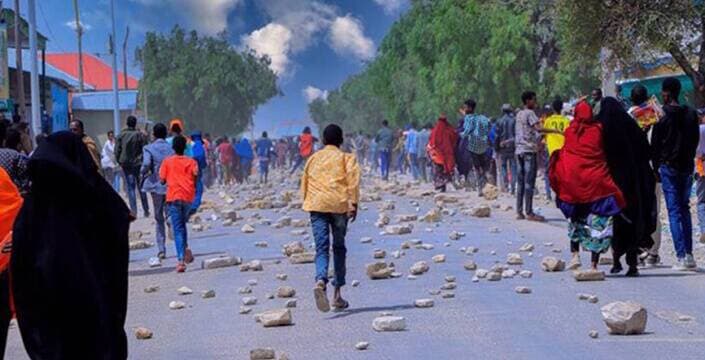
For more than three decades, Somaliland was regarded as the only peaceful, stable, and democratic de facto state in the Horn of Africa. Apart from Kenya, which had some ethnic violence as a result of the post-election conflict, Ethiopia, Somalia, Djibouti, Eritrea, Sudan, and South Sudan all experienced at least one full-fledged war over the same time period. This era appears to be coming to an end, as Somaliland has been added to the list of conflict-torn countries. With a small protest by disgruntled clan leaders evolving into a bloody conflict at Las Anod, the de-facto state is now in a terrible situation, affecting even neighboring Ethiopia, which is sheltering Somalilanders who have been displaced by the conflict.
The violence in Las Anod began on December 26, 2022, with the death of a local opposition figure, Abdifatah Abdullahi Abdi, by unknown assailants, sparking anti-government rallies around the city. The response of Somaliland’s security forces was unexpected. Social media footage showed them firing weapons at demonstrators, killing at least 20 people during the early December protests that stretched into January.
Yet, by the end of January, peace had returned to Las Anod and its capital, Sool. Since February 6, 2023, however, fighting has resumed between Somaliland’s army and militias claiming to represent the Dhulbahante clan, a majority in Las Anod that seeks independence from Somaliland. The violence in Las Anod, like all other battles in Somalia, is motivated by clan politics.
The Dhulbahante clan claims Las Anod as its capital, and it is the most dominant clan in much of Sool. Somaliland, which bases its borders on those of British Somaliland, considers Sool to be part of its territory. Since 2007, when Somaliland took Las Anod from forces allied with the semi-autonomous province of Puntland, the Somaliland government has loosely controlled Sool and its capital, Las Anod.
The announcement by Dhulbahante elders in Sool that they will form their own federal state under Somalia called SSC-Khaatumo heightened an already tense situation.
“We have determined that the Federal Republic of Somalia will manage the SSC-Khaatumo region until the federalization of Somalia’s land is completed,” they stated in a statement, citing the Somali constitution. Reports indicate that forces from Hargeisa, Somaliland’s capital, invaded Las Anod shortly before the statement was scheduled to be released, and forces loyal to the clans fought back.
Although the government of Somaliland declared a unilateral truce in February and clan leaders from across the country attempted to intervene, fighting between the military and clan-aligned militias has escalated since then. There is a possibility that forces from neighboring Puntland, which the government of Somaliland accuses of aiding the insurrection in Las Anod, are being drawn into the conflict too.
British Somaliland was a colony of the United Kingdom until 1960, when it declared independence and subsequently united with Somalia. In May 1991, Somaliland declared its independence after a civil war broke out and President Siad Barre’s government collapsed. Despite having a functioning government and holding free and fair elections on a regular basis, neither Somalia nor any other country recognizes Somaliland as an independent state.
The country has been praised, however, for its political stability and peaceful transfers of power. But the current conflict in the de facto state indicates keeping up the momentum is not easy.
Parts of Sool and Sanaag, which are located inside Las Anod, opposed secession and did not vote in Somaliland’s 2001 constitutional referendum to split from Somalia, according to Somali affairs expert Markus Virgil Hoehne. Even if the country’s central and western regions have flourished, the country’s eastern regions are “not yet at peace,” and Somaliland has a weak presence there, according to him.
In early 2023, he made an important remark warning of the potential for “further escalation into large-scale violence” and urging the international community to use their influence to secure a peaceful resolution.
In the meantime, analysts are warning that al-Shabaab will almost definitely use the crisis to its advantage. The government of Somaliland has already warned that al-Shabaab members have managed to infiltrate some of the militias fighting for control of Las Anod. There is no concrete proof from publicly available sources that al-Shabaab has taken advantage of the instability in and around Las Anod to establish itself in the eastern districts of Somaliland, but this is a strong possibility.
Puntland is home to both al-Shabaab and the Islamic State of Somalia (ISS), and both groups have a strong foothold there. Michael Horton, a fellow at the Jamestown Foundation, claims that for years, al-Shabaab’s intelligence wing, the Amniyat, has carefully analyzed and exploited clan tensions for its own profit. If the fighting in Las Anod isn’t stopped soon through dialogue, he’s afraid the situation may escalate and spread to adjacent places. He cautioned that “Al-Shabaab and the Islamic State in Somalia will be the major beneficiaries” of such a development.
Political analyst Michael Rubin sees this conflict more as a proxy war. If Somaliland’s Western-leaning administration had not rejected China and instead recognized Taiwan, there wouldn’t be violence in Las Anod, according to him.
However, “the State Department’s kneejerk both-sidesism, if not deference to Mogadishu, puts the United States in the uncomfortable position of supporting communist China as it seeks to destabilize, if not destroy, one of the most pro-Western and most democratic countries in the Horn of Africa,” Rubin said.
Comments
No comments yet. Be the first to leave a comment!
Leave a Comment

Society
Old Jaffa, New Tel Aviv
November 22, 2025

Society
“Now, It’s My Land”: Legal Reform Transforms Women’s Ownership in Rural Ethiopia
November 15, 2025

Society
A Gift of Technology — and Hope — for Koye’s Students
November 08, 2025
Society
Data for a Changing Climate: From Soil to Strategy
November 01, 2025

Society
Harnessing Data, Driving Innovation: Securing East Africa’s Water Future
October 25, 2025

Society
Bridging the Health Gap: Ethiopia’s push for Equitable Health
October 18, 2025
Art
Blending traditions: A taste of Italy, Crafted with Ethiopian ingredients
December 06, 2025
Art
Between Tradition and Trend: Ethiopia’s Musical Identity in the Modern Era
November 29, 2025
Art
Ethiopia’s Living Heritage in the Holy Land
November 22, 2025
Art
The Door that Never Closed: Honoring Getnet Enyew
November 15, 2025
Art
Echoes of Memory
November 01, 2025

Global Addis
April 29, 2023
War-torn capital poses threat to the entire region

Global Addis
April 15, 2023
Tectonic shift in world order upends fuel market

Global Addis
April 08, 2023
Egypt’s business as usual approach rekindles GERD dispute
Global Addis
April 01, 2023
Africans’ restricted movement endangers continent’s economic growth, openness

Global Addis
March 25, 2023
Kenyans protest—why?

Global Addis
March 18, 2023
Concerns, hopes surrounding Ethiopia, US relations

Global Addis
March 11, 2023
Isaias transition from depths of wild to halls of diplomacy
Global Addis
March 04, 2023
Somaliland loses security to clan politics